Posted in Historic Fiction, Horror

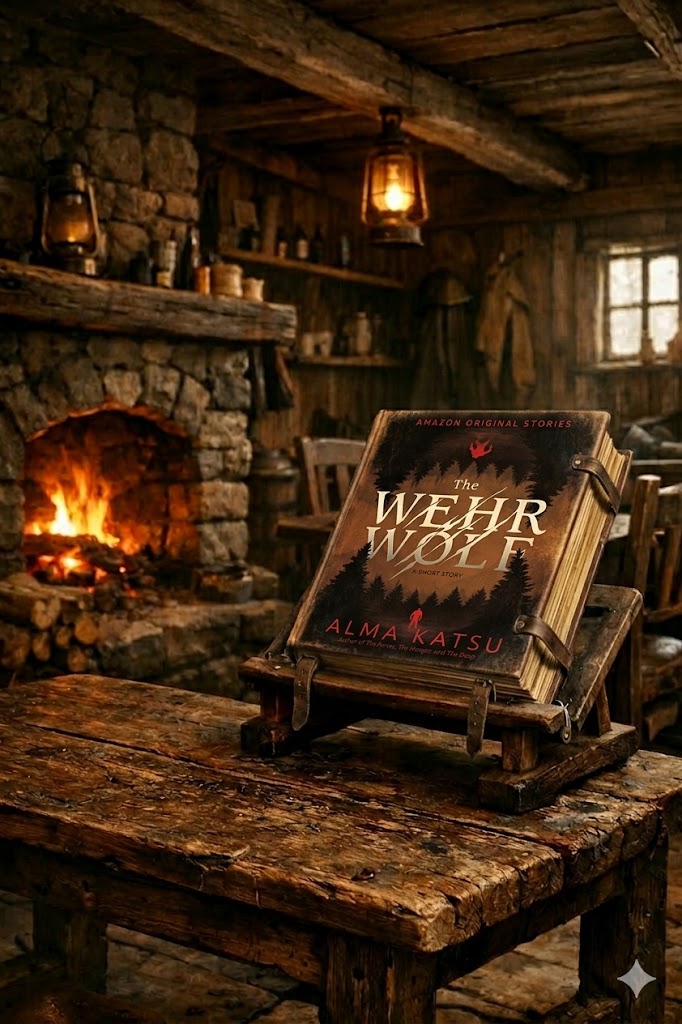
The Wehrwolf

Title: The Wehrwolf

Author: Alma Katsu

Pages: 79

Genre: Horror, Historical Fiction

Alma Katsu, the visionary author of The Fervor, The Hunger, and The Deep, brings readers a terrifying short story about monsters among men—and the thin lines that divide them.

Germany, 1945. In the waning days of World War II, the Nazis have been all but defeated. Uwe Fuchs, never a fighter, feels fortunate to have avoided the front lines as he cared for his widowed mother.

But Uwe’s fortune changes when Hans Sauer, the village bully, recruits him to join a guerilla resistance unit preparing for the arrival of Allied soldiers. At first, Uwe is wary. The war is lost, and rumor has it that Hans is a deserter. But Hans entices him with talk of power, brutality, and their village’s ancestral lore: werewolves.

With some reluctance, Uwe joins up with the pack and soon witnesses their startling transformation. But when the men’s violent rampage against enemy soldiers takes a devastatingly personal turn, Uwe must grapple not only with his role in their evil acts but with his own humanity. Can he reclaim what this group of predatory men has stolen from him?

Or has he been a monster all along?

Evenin’ Brave Bookworms!

I came across this short story by Alma Katsu while browsing Kindle, and honestly, it sounded right up my alley. WWII with a horror twist? That’s practically irresistible in this house.

Unfortunately, that spark of excitement faded far too quickly.

The idea is genuinely interesting, but the execution fell flat. I was pretty bored, which is not what you want from something that should feel tense and eerie. I get that it’s a short story, but there was barely any character development, and the setting didn’t feel immersive at all. I wanted atmosphere, something cold, heavy, unsettling and it just wasn’t there.

I also struggled with the historical inconsistencies. While the fictional village of Scharweg is never clearly placed, the interactions between Russian and American forces in early 1945 didn’t quite align. Certain character backstories, particularly regarding desertion and military service, felt off in ways that pulled me out of the story rather than grounding me in it. If you are going to incorporate historical information in your work, I think it should be accurate.

What makes this especially frustrating is that the concept had so much potential. The real WWII Werwolf program which was intended as a last-ditch guerrilla resistance, offers such a sinister foundation. Twisting that into something truly monstrous, could have been deeply unsettling. Instead, it leaned more into village folklore, which just didn’t hit as hard.

And unfortunately… it was predictable. I pretty much knew where it was going the whole time.

In the end, I appreciated the effort in blending historical fiction with horror, but this one didn’t quite land for me.

Hope you enjoyed the review and until next time…

Meet you after dark

💀Your cozy-macabre book bestie


Posted in Historic Fiction, Mystery

Silence for the Dead

Original post from my Mom blog here – https://mamaonthemove1.wordpress.com/2025/10/14/book-review-silence-for-the-dead/

Title: Silence for the Dead


Author: Simone St. James


Genre: Historical Fiction, Mystery, Horror, Paranormal, Fiction


Number of Pages: 363


My Rating: 💋💋💋💋💋


Book Summary:

In 1919, Kitty Weekes, pretty, resourceful, and on the run, falsifies her background to obtain a nursing position at Portis House, a remote, once magnificent estate turned hospital for soldiers left shell-shocked by the horrors of the Great War. Hiding the shame of their mental instability, the patients suffer from nervous attacks and tormenting dreams. But something more is going on at Portis House – its plaster is crumbling, its plumbing makes eerie noises, and strange breaths of cold air waft through the empty rooms. And why do the patients share the same nightmare, one so horrific that they dare not speak of it?

Kitty finds a dangerous ally in Jack Yates, an inmate who might be a war hero, a madman…or maybe both. But even as Kitty and Jack create a secret, intimate alliance to uncover the truth, disturbing revelations suggest the presence of powerful spectral forces. And when a medical catastrophe leaves them even more isolated, they must battle the menace on their own, caught in the heart of a mystery that could destroy them both.


My Thoughts:

I’m a sucker for books based on early medical practices, hospitals and mental asylums so this one immediately caught my eye on bookoutlet.ca. I was worried it was going to be an extremely slow burn, but the pace was steady. Though if you aren’t into a little romance mixed into your haunting, I’d skip this one. It may not be for you.

An old, decaying mansion converted into a medical facility, known as Portis House, for soldiers suffering from shell-shock and other mental maladies from the war. The perfect atmosphere to set a spooky ghost story. However, this story is filled with not only a mystery and haunting, but a story of self-discovery, friendship and a little bit of romance.

You quickly learn that Kitty is running from her past, falsifying her resume as a nurse to acquire a job at Portis House. However, the head nurse and her boss, quickly calls her out on her deception but keeps her due to the sheer fact the facility is understaffed and desperate for nurses. She basically has to learn hands on and quickly.

Kitty discovers immediately that this isn’t the easiest line of work and she is tested both physically and mentally on a daily basis. But her will is strong and her personality stubborn, she does gain some allies in other staff members and even some of the patients. Her main ally being Jack Yates, or patient 16, his identity being kept secret from the other patients until Kitty decides she just needs to know. Discovering the war hero and becoming enamored with one another as they begin to unfold the evil that is plaguing the patients and the mystery of Portis House.

The growth of the characters, especially Kitty, was nicely done and the stead unraveling of the mystery that surrounds Portis House was intriguing. I loved the subtle twists and turns, the pieces of the puzzle falling into place nicely. And I personally liked that Kitty and Jack got a bit of a happy ending.

All in all I give this book five Baci due to the historical setting, the gothic mystery and who doesn’t like a ghost story set in an old, decaying mansion turned medical facility. Wonderful story-line and cast of characters, would definitely recommend and one I’ll be keeping on my shelf. I’ll definitely be reading more from author Simone St. James!

I’m currently reading Ghost Camera by Darcy Coates.

Hope you enjoyed and keep an eye out for the next review!

Ciao!

Posted in Historic Fiction

The Countess

Original post from my Mom blog here – https://mamaonthemove1.wordpress.com/2025/07/24/book-review-the-countess/

Title: The Countess


Author: Rebecca Johns


Genre: Historic, Fiction, Historical Fiction


Number of Pages: 355


My Rating: 💋💋💋💋


Book Summary:

Was the “Blood Countess” history’s first and perhaps worst female serial killer? Or did her accusers create a violent fiction in order to remove this beautiful, intelligent, ambitious foe from the male-dominated world of Hungarian politics?
 
In 1611, Countess Erzsébet Báthory, a powerful Hungarian noblewoman, stood helpless as masons walled her inside her castle tower, dooming her to spend her final years in solitary confinement. Her crime—the gruesome murders of dozens of female servants, mostly young girls tortured to death for displeasing their ruthless mistress. Her opponents painted her as a bloodthirsty škrata —a witch—a portrayal that would expand to grotesque proportions through the centuries.

In this riveting dramatization of Erzsébet Báthory’s life, the countess tells her story in her own words, writing to her only son—a final reckoning from his mother in an attempt to reveal the truth behind her downfall. Countess Báthory describes her upbringing in one of the most powerful noble houses in Hungary, recounting in loving detail her devotion to her parents and siblings as well as the heartbreak of losing her father at a young age. She soon discovers the price of being a woman in sixteenth-century Hungary as her mother arranges her marriage to Ferenc Nádasdy, a union made with the cold calculation of a financial transaction. Young Erzsébet knows she has no choice but to accept this marriage even as she laments its loveless nature and ultimately turns to the illicit affections of another man.

Seemingly resigned to a marriage of convenience and a life of surreptitious pleasure, the countess surprises even herself as she ignites a marital spark with Ferenc through the most unromantic of the violent punishment of an insolent female servant. The event shows Ferenc that his wife is no trophy but a strong, determined woman more than capable of managing their vast estates during Ferenc’s extensive military campaigns against the Turks. Her naked assertion of power accomplishes what her famed beauty could capturing the love of her husband.

The countess embraces this new role of loving wife and mother, doing everything she can to expand her husband’s power and secure her family’s future. But a darker side surfaces as Countess Báthory’s demand for virtue, obedience, and, above all, respect from her servants takes a sinister turn. What emerges is not only a disturbing, unflinching portrait of the deeds that gave Báthory the moniker “Blood Countess,” but an intimate look at the woman who became a monster.


My Thoughts:

I thoroughly enjoyed this novel once I became immersed in it; however, if you’re expecting a gothic tale of vampires or a fast-paced thriller about cold-blooded murders, you may find yourself disappointed.

The novel is a beautifully written fictionalized memoir of the real-life Hungarian Countess Erzsébet (Elizabeth) Báthory, infamously known as the “Blood Countess” due to the numerous young servant girls who were murdered under her care. Within the story, she is also portrayed as an “evil stepmother” figure to these girls. Though she welcomed them into her home with good intentions—offering them basic education, providing dowries, and at times even attempting to arrange marriages—any misstep on their part was met with harsh and often brutal punishment, laced with pain and deep humiliation.

The author doesn’t just paint a portrait of her cruelty, but elegantly paints a profile of a beautiful, strong, intelligent and well-educated woman. In a time where woman were coveted for their beauty and ability to bare children and provide an heir. But behind every great man, was a woman who ran the house and holdings. The Countess was a master at all of it, which I believe is what got her into trouble later in life.

However, the Countess had been through her fair share of hardships and cursed love affairs. Ultimately, every man whom she gives her love and affection to, including her son, pass her over for someone else. She fears she’ll never feel love again, and that one day she’ll be left powerless and ignored by men. This fear slowly drives her mad—until it ends, quite literally, in bloody murder.

But this isn’t a story about madness or a woman feeling sorry for herself. Instead, it’s a vivid tale of a clever, strong-willed woman trying to protect her family’s power during a time of war and shifting loyalties. The story focuses so much on her political and emotional strategies that the murders of the young girls in her care don’t come to the forefront until much later. By then, Bathory has revealed herself as smart, witty, charming, and generous—so much so that, it’s hard to believe she could truly be guilty.

The author’s focus on Countess Bathory’s childhood gives the story real depth. Without it, The Countess would be just another tale about a heartless killer—a typical, blood-soaked narrative full of violence but lacking substance.

This novel shows how deep, hidden fears can slowly damage the mind—especially when a woman like Elizabeth Bathory is forced to live under strict rules that leave her and her children vulnerable to betrayal, poverty, violence, and even death. On the surface, she seems calm and collected, but internally the pressure and fear quietly build.

In the end, Elizabeth’s violent outbursts make sense as the result of constant stress, emotional loss, and betrayal. Especially after losing some of her children and being rejected and humiliated by the men she depended on for safety.

My only critique is that the story moved a bit slowly at times, and I would’ve liked to read more about the trials involving her servants. Bathory’s fate was sealed when she was bricked into her tower, where she stayed until the end of her life.

That said, I definitely recommend this novel if you enjoy a rich, engaging historical read that leaves you questioning what really happened. The the depictions of the murders are not for the weak of heart, so be forewarned. I’ve always been fascinated by the story of Elizabeth Bathory, and this book only made me more curious. Rebecca Johns’ writing is wonderfully done, and I’ll absolutely be checking out more of her work!

Hope you enjoyed the review!

Ciao!